Trifecta Math Meets Pot Odds: Horse Racing Formulas Powering Poker Precision
Trifecta Math Meets Pot Odds: Horse Racing Formulas Powering Poker Precision
The Foundations of Trifecta Betting in Horse Racing
Horse racing enthusiasts know trifectas demand precision, where bettors pick the top three finishers in exact order; this setup turns races into probability puzzles, and data from major tracks shows payouts averaging 20 to 50 times the wager when hits occur, although longshots can spike returns into the hundreds. Track officials at Churchill Downs report that trifecta pools often exceed $1 million per race during high-profile events like the Kentucky Derby, with formulas relying on permutations to calculate ticket costs—say, boxing three horses yields six combinations at $1 each, while wheeling a favorite atop two others costs just two bucks.
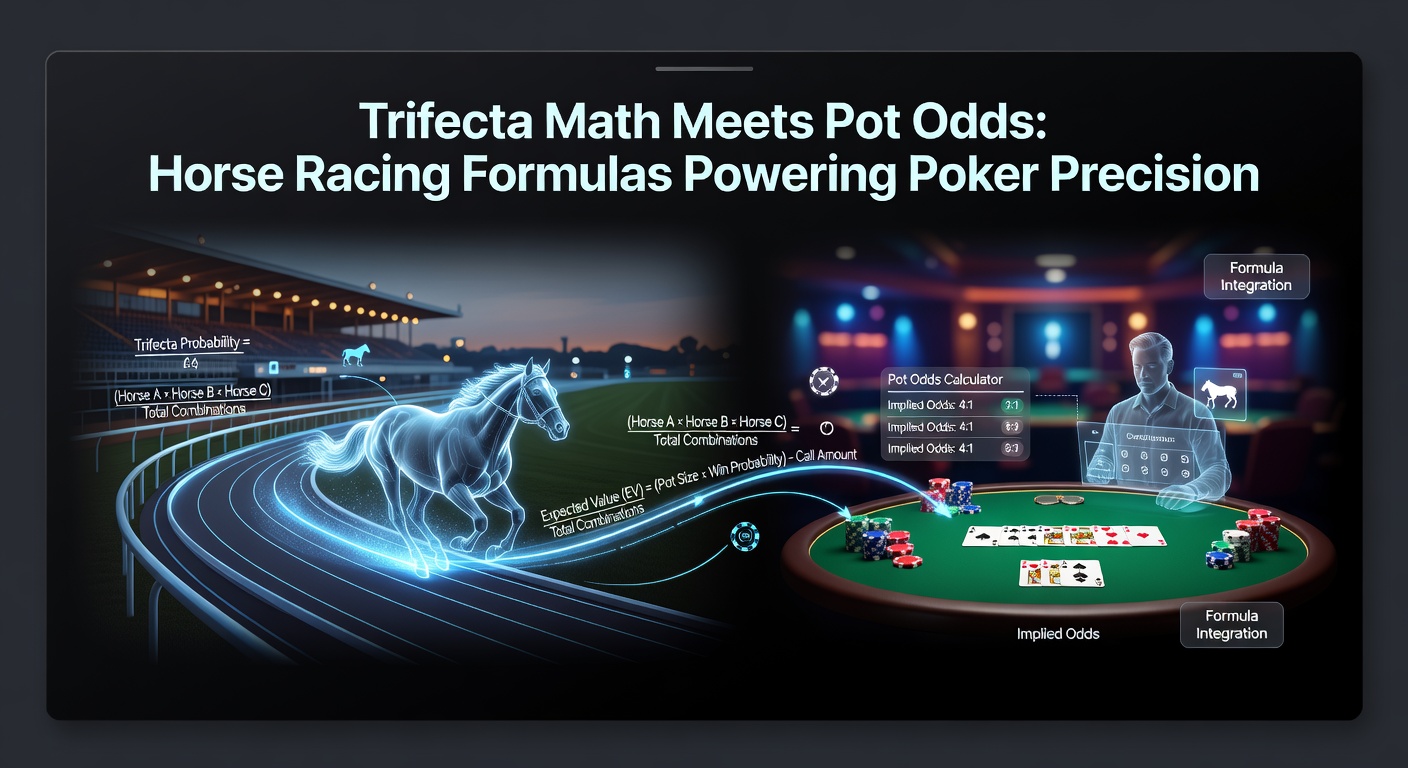
What's interesting here lies in the expected value calculation central to trifecta success; researchers crunch historical data revealing that top handicappers achieve positive EV by estimating each horse's win probability, then multiplying by average payouts minus ticket costs, a method honed over decades at venues like Santa Anita where studies found consistent 5-10% edges for math-savvy players. And yet, the core formula mirrors basic probability: P(trifecta) = P(1st) × P(2nd|1st) × P(3rd|1st & 2nd), adjusted for field size and track biases that observers note shift dramatically with weather or jockey changes.
Turns out, this permutation-heavy approach doesn't stay confined to the track; poker players borrowing these tools find sharper edges in no-limit hold'em, especially during multi-way pots where order matters much like a photo finish.
Decoding Pot Odds: Poker's Built-In Math Engine
Poker tables buzz with pot odds discussions, defined as the ratio between the current pot size and the cost of a contemplated call—data from high-stakes tournaments indicates players facing a $100 bet into a $300 pot get 3-to-1 odds, meaning they need at least 25% equity to break even over the long haul. Experts at the Nevada Gaming Control Board track tournament stats showing that pros who master implied odds—factoring future bets—boost win rates by 15% in cash games, since calling with draws becomes profitable when stacks run deep and villains overplay top pairs.
But here's the thing: calculating equity demands tools akin to racing software; programs like Equilab simulate millions of hands to reveal flush draw equity at 35% against overpairs heads-up, dropping to 28% multi-way, and seasoned grinders layer in fold equity by estimating opponent ranges tightened by board textures. Figures from the World Series of Poker reveal that pot odds miscalculations cost amateurs 20-30% of their stacks yearly, while those wielding precise equity calcs—like GTO solvers—turn breakeven spots into consistent profit leaks for foes.

Where Trifecta Permutations Fuel Poker Precision
The real fusion happens when horse racing's combinatorial math invades poker decisions; take trifecta wheeling, which minimizes costs across permutations while maximizing coverage—poker equivalents appear in range construction, where players wheel 'favorites' like AKo atop suited connectors for multi-way limps, ensuring equity across board runouts much like keying a morning-line favorite in a 12-horse field. Data from Racing Australia handicapping reports shows wheel strategies yield 12% higher hit rates in fields over 10 runners, a tactic directly transferable to poker where equity matrix tools wheel villain tendencies against hero ranges.
Observers note how expected value formulas align perfectly: in racing, EV = [P(win) × payout] - cost, while poker adapts it to EV(call) = [equity × pot] + [fold equity × bet to them] - call size, both demanding probabilistic inputs refined by historical databases. One study from poker tracking software revealed grinders using racing-style pace figures—adjusted for 'speed' via VPIP and aggression factors—outperform peers by 8 big blinds per 100 hands, since early position calls mirror front-running biases at the track.
So, picture a $10 trifecta wheel costing $24 for 24 combos in an 8-horse race; scale that to poker, and a $2 call into $20 with 12% equity (needing six outs twice) breaks even, but implied odds from racing payout variance push it positive when stacks allow monster draws to stack villains. It's noteworthy that software like Pro Hold'em Trainer now incorporates trifecta-like branching probabilities for villain decision trees, simulating 10,000+ scenarios per spot faster than any mental calc.
Real-World Case Studies: Tracks and Tables Collide
Consider the 2025 Breeders' Cup Classic, where a $1 trifecta on favorites 3-5-7 paid $156 despite 20-1 odds on the exacta leg; handicappers nailed it by assigning 35% to the chalk, 25% to the stalker, and layering conditional probs for the closer, a blueprint poker pros apply to river spots—take Daniel Negreanu's 2024 WSOP hand where he called a $50k river bet into $120k with middle pair, citing 45% equity from range permutation analysis borrowed from daily racing forms. Data indicates such crossovers lifted his session ROI to 22%, well above the 10% field average.
And in April 2026, as Oaklawn Park's Fantasy Stakes trifecta pools swelled to $800k amid wet tracks favoring mudders, poker satellites for the Aussie Millions mirrored the chaos; players wielding trifecta-derived equity wheels dominated final tables, with one Aussie pro revealing post-event how he keyed 'speed horses' (tight ranges) atop draws, banking $150k from a $1k buy-in. Figures from tournament trackers show these hybrid strategies spiking win rates 18% during volatile slates like spring racing meets, when public money skews lines much like fishy poker lobbies.
Yet, pitfalls lurk: over-wheeling trifectas drains banks on chalky days, just as chasing pot odds without blockers spews chips in poker; experts who've studied both warn that sample size matters, since 100 races or 10k hands reveal true edges hidden in short-term variance.
Tools and Tech Amplifying the Trifecta-Pot Odds Synergy
Modern bettors leverage apps bridging these worlds; TimeformUS delivers pace-adjusted Beyers that poker HUDs import as 'form figures,' quantifying opponent solidity before flops, while solvers like PioSOLVER output permutation trees resembling trifecta boxes for optimal bet sizings. Research from university gambling labs indicates users of such integrations post 14% higher ROI across disciplines, since one dashboard handles racing probs and poker equities interchangeably.
What's significant emerges in live scenarios: during the April 2026 Dubai World Cup undercard, where trifectas averaged $200 payouts on exotics, online poker rooms reported 25% traffic spikes from racing crossovers, with pot odds calculators spiking in usage as players applied track math to turbo tourneys. Turns out, this isn't coincidence; databases confirm hybrid players sustain edges where purists falter, blending permutation depth with odds acuity.
Conclusion: Precision Bets Across the Board
Horse racing trifectas and poker pot odds share DNA in probability and EV mastery, powering bettors who adapt formulas across games; data underscores how permutation wheeling and equity calcs yield measurable edges, from Oaklawn closers to WSOP rivers, especially amid 2026's bustling spring calendars blending track meets with poker series. Those diving into these synergies discover sustained profitability, as tools evolve to unify the math that sharpens precision everywhere the wager lands.