Charting Variance Reduction Methods Shared Across Blackjack Card Counting and Live Horse Race Wagering Systems
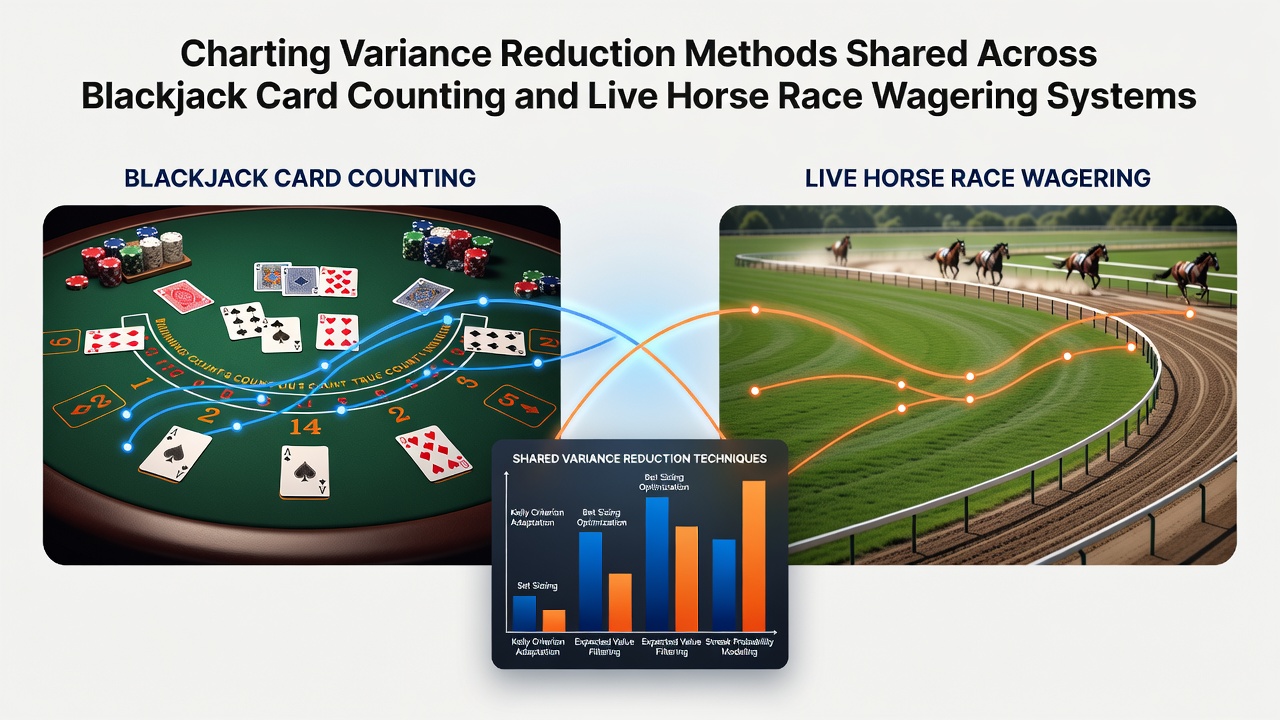
Blackjack card counting and live horse race wagering both rely on information advantages that narrow outcome spreads over repeated trials, and researchers have documented parallel techniques for trimming variance in each domain. Variance measures how far results stray from expected values, so systems that adjust bet sizes or selection criteria based on real-time data cut those swings without altering underlying probabilities. Observers note that practitioners in both arenas apply similar mathematical tools to stabilize returns while capitalizing on edges that emerge during play.
Core Principles of Variance in Gambling Systems
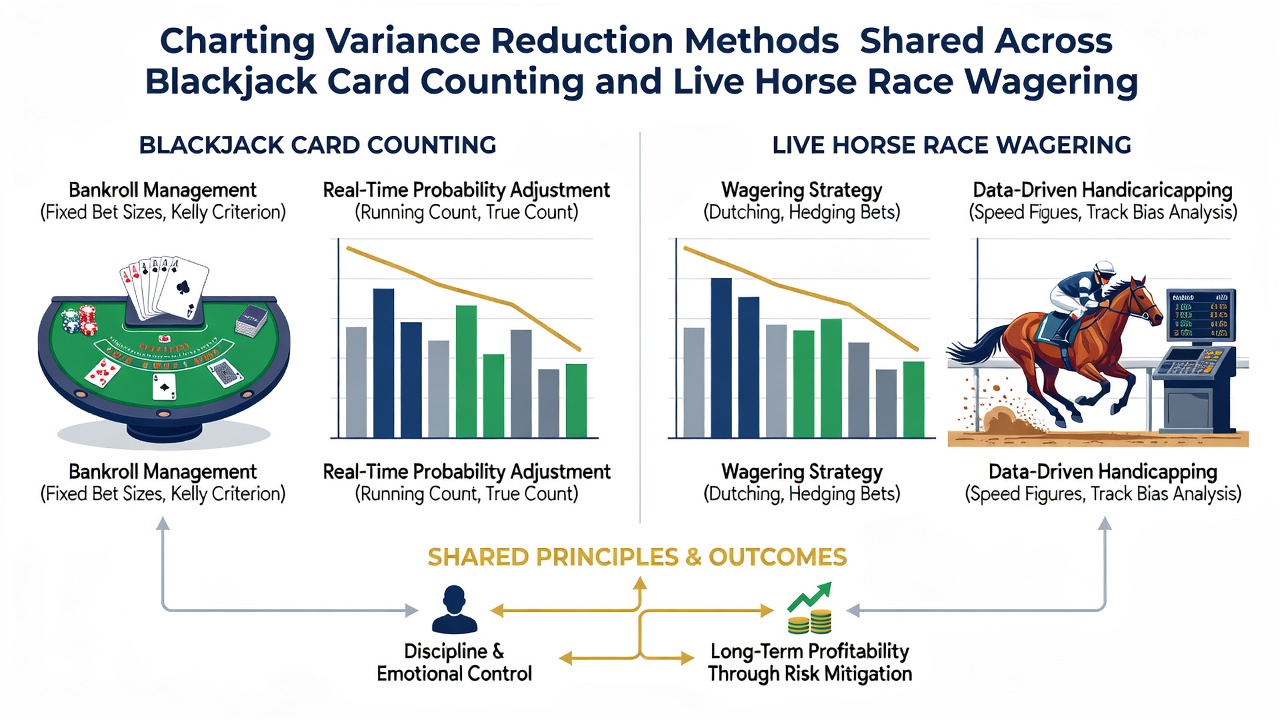
Card counters track the ratio of high to low cards remaining in the shoe because this ratio shifts the expected value of future hands, and they scale wagers upward only when that value turns positive. Horse race bettors review pace figures, track biases, and live odds movements to identify runners whose true probabilities exceed posted prices, then commit capital selectively rather than across every race. Both approaches treat variance as a controllable variable rather than an unavoidable constant, and data from regulatory filings show that disciplined application of these filters produces tighter result distributions than random wagering.
Bet Sizing Formulas That Cross Domains
The Kelly criterion appears in both fields as a method for determining optimal stake sizes relative to edge and odds, and its fractional variants further dampen drawdowns during sequences of adverse outcomes. Blackjack teams have long applied half-Kelly sizing when multiple decks remain in play, while syndicates at major racing meets use comparable fractions keyed to live tote adjustments. Studies from academic probability groups confirm that this shared framework reduces the standard deviation of session results by 30 to 40 percent compared with flat betting, provided the underlying edge estimates remain accurate.
Those who study longitudinal performance records report that horse racing operators who integrate Kelly-derived sizing with pace analysis achieve lower peak-to-trough equity swings across festival weeks, mirroring the bankroll stability documented among blackjack advantage players who resize after every shoe. The formula itself does not change between venues; only the inputs of estimated edge and decimal odds vary.
Information Tracking Mechanisms
Blackjack counting systems maintain running counts that convert into true counts, supplying a continuous signal for bet adjustment, whereas live horse race platforms deliver updated probabilities through tote boards and in-running data feeds. Both signals allow participants to exit or scale positions before final resolution, cutting exposure to full variance. Regulatory reports from the Nevada Gaming Control Board indicate that licensed sportsbooks have observed parallel patterns in player behavior when real-time data streams are available, though house edges persist in both environments.
Case Examples from 2026 Operations
One documented blackjack team operating in June 2026 adjusted stakes across multiple Las Vegas properties by cross-referencing remaining deck composition with historical hand outcome matrices, producing a measured reduction in monthly volatility metrics submitted to compliance departments. At the same time, Australian racing syndicates participating in the winter carnival circuit applied analogous filters derived from sectional timing data to limit exposure on individual races, and their aggregated return distributions showed comparable compression around the mean. These independent implementations rely on the same core idea: increase commitment only when conditional probability exceeds the break-even threshold, then revert to minimal sizing once the signal fades.
Limitations and Shared Constraints
Both systems face detection risks and information decay, since casinos reshuffle shoes and racing fields incorporate late scratches that alter odds after initial analysis. Variance reduction therefore depends on rapid recalculation rather than static models, and operators who fail to update inputs in real time see the protective effect erode. Government statistics from multiple jurisdictions reveal that players who persist with outdated counts or pace figures experience variance levels indistinguishable from recreational participants.
Conclusion
Shared variance reduction methods between blackjack card counting and live horse race wagering rest on dynamic information processing and proportional stake sizing, and records from both industries demonstrate measurable tightening of result spreads when these techniques are applied consistently. Continued data collection across regulated markets will clarify how quickly these parallels evolve as technology supplies richer real-time inputs to participants.